Japanese katakana · 11 min read
·
The Origin and Use of Katakana: The Script for Foreign Words
Once you have hiragana, katakana comes surprisingly fast. The same forty-six syllables, the same gojūon order, the same "Akasztana ha majré van" logic — just with more angular shapes. Yet I see that learners are much less confident with katakana than with hiragana, and this isn't due to the characters, but to usage: they encounter it less in textbooks, whereas out on the streets of Japan it's everywhere.
In this article we'll go through how the katakana writing system developed, exactly what the Japanese use it for, how the transcription of foreign words works, when it serves for emphasis, and what the real difference is compared with Japanese hiragana.
The origin of the katakana writing system
Katakana and hiragana come from the same source, the man'yōgana system, but by completely different paths. While hiragana softened out of cursive, flowing handwriting, katakana was created by Buddhist monks around the 9th century for a practical reason: they were reading sutras in Chinese and scribbled small notes between the lines about how to read a given passage in Japanese.
The margin was narrow and time was short, so instead of writing the full kanji, they wrote only a single piece of it. The name "katakana" reflects this: kata = part, fragment. Hence the angular shape — these are actually kanji fragments.
- 阿 → ア (a) — the left-hand element remained.
- 伊 → イ (i) — the left-hand "person" radical.
- 宇 → ウ (u) — the upper roof part.
- 江 → エ (e) — the right-hand component.
- 於 → オ (o) — the left-hand piece.
- 多 → タ (ta), 三 → ミ (mi), 川 → ツ (tsu) — all fragments of a larger character.
This origin explains why katakana looks "technical," "official," and "modern." For a long time it really was the writing of official documents, laws, and the military: pre-World War II Japanese legal texts were written with a kanji + katakana combination, without hiragana. After the war the roles reversed, and hiragana became the default kana for running text.
Az írásjegyek akkor rögzülnek igazán, ha valaki azonnal visszajelez a vonássorrendre és az olvasatokra. Ezt gyakoroljuk együtt a japán nyelvórákon Budapesten és online, ahol minden hétre kapsz személyre szabott íráshoz kötött feladatot is.
„A katakana nem másodrangú ábécé: ezen múlik, hogy elboldogulsz-e Japánban a mindennapokban.”
Foreign words: the world of gairaigo
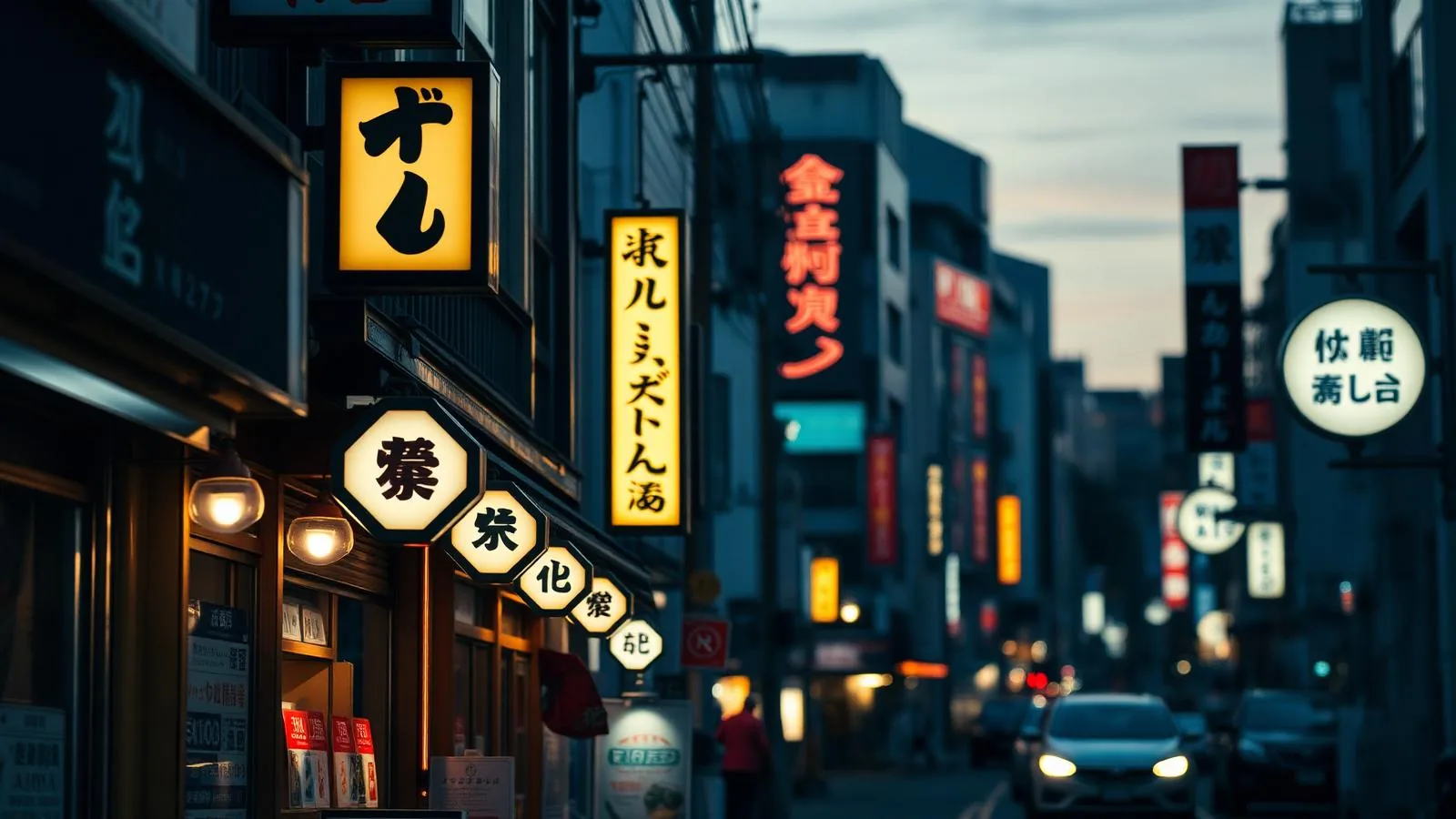
Katakana's most important role today is writing gairaigo, words of foreign origin. Roughly ten percent of modern Japanese vocabulary is of this kind, and in technology, food, or business topics this proportion is much higher. If you look around the streets of Tokyo, a large share of the signs are in katakana.
- コーヒー (kōhī) — coffee. The ー marks a long vowel; it's used this way only in katakana.
- コンピューター (konpyūtā) — computer.
- ハンガリー (Hangarī) — Hungary. Country names and foreign personal names are also written with katakana.
- アルバイト (arubaito) — part-time job, from the German word "Arbeit."
- パン (pan) — bread, from the Portuguese word "pão," dating back to the 16th century.
- テレビ (terebi) — television, with a typical Japanese abbreviation.
The transcription has its own logic, and it's worth understanding, because then it becomes predictable. The Japanese syllable structure is very strict: consonant + vowel. Because of this, a vowel is inserted into every foreign consonant cluster, typically "u," and "o" after t and d.
- strike → ストライク (sutoraiku): a vowel is needed after every consonant.
- milk → ミルク (miruku): l always becomes r.
- bed → ベッド (beddo): an o is added after the word-final d.
- coffee shop → コーヒーショップ: long sounds are marked with ー.
There are also so-called extended katakana combinations that don't exist in hiragana, because they represent sounds that don't originally exist in Japanese: ファ, フィ, ウェ, ヴィ, ティ, ディ, チェ. That's why "party" becomes パーティー, and "violin" becomes ヴァイオリン or バイオリン.
Emphasis, style, and other functions
Katakana isn't only for foreign words. It also has a typographic role, roughly equivalent to italics or capital letters in English. If a Japanese word that would normally be written in kanji or hiragana is written in katakana instead, that's emphasis.
- Emphasis: ダメ (no good, forbidden) — it can also be written in kanji, but katakana makes it more emphatic.
- Onomatopoeic and mimetic words: ドキドキ (heart pounding), キラキラ (sparkling), ゴロゴロ (rumbling, lazing around).
- Plant and animal names in technical texts: ネコ, サクラ, イヌ — in biological and scientific contexts.
- Brand and product names: ソニー, トヨタ, ヤマハ.
- Menus, advertisements, packaging: katakana creates a modern, fresh impression.
- Manga and novels: marking robots, foreigners, or unusual speech patterns with katakana dialogue.
- Telegrams, legacy systems, and certain forms where only katakana is permitted for names.
This stylistic layer is something textbooks rarely teach, even though it's essential for real reading comprehension. If every line of a character in a manga is set in katakana, it's not an accident: they might not be a native Japanese speaker, might be a robot, or might simply have a strange voice.
What's the difference compared with hiragana?
The two kana systems cover exactly the same set of sounds — this is important: あ and ア are exactly the same sound. The difference lies purely in function and form.
- Form: hiragana is rounded and flowing; katakana is angular, with straight strokes.
- Function: hiragana = grammar, native Japanese words, furigana. Katakana = loanwords, names, onomatopoeia, emphasis.
- Marking long sounds: with a repeated vowel in hiragana (おかあさん), with a bar in katakana (ケーキ).
- Origin: hiragana comes from the whole of cursive kanji, katakana from a fragment of kanji.
- Occurrence: hiragana dominates in running text, katakana on signs and products.
A mixed sentence shows everything: 私はコンビニでコーヒーを買いました ("I bought coffee at the convenience store"). Here 私 and 買 are kanji, は, で, を, いました are hiragana, and コンビニ and コーヒー are katakana. Three writing systems in a single sentence — and this is exactly what makes Japanese text readable, since Japanese has no spaces. The switch between writing systems itself marks word boundaries.
Why does this matter for learning Japanese?
Many learners neglect katakana because the first chapters of textbooks are mostly in hiragana. Then, arriving in Japan, it turns out that a large share of menus, timetables, store shelf labels, and hotel information is in katakana. Weak katakana skills are one of the most common reasons someone still reads uncertainly even at N4 level.
- Speeds up vocabulary growth: you get thousands of English-derived words practically for free once you understand the transcription logic.
- Essential for JLPT reading comprehension, starting from N5 level.
- Also needed to write your own name — as a foreigner, you write yourself in katakana.
- In real Japanese environments (streets, shops, websites), this is the most frequently seen kana.
Common mistakes
- Confusing ツ and シ, ソ and ン. The trick is the stroke direction: the strokes of ツ and ソ go from top to bottom, while those of シ and ン start from the bottom, going left to right.
- Dropping the ー long-vowel mark: コーヒー and コヒー are not the same — the latter is meaningless.
- Forcing English-style pronunciation: ホテル is not "hotel" but ho-te-ru, with three equal morae.
- Assuming every gairaigo means the same as the original word: マンション is not a mansion but a condominium apartment; ナイーブ doesn't mean naive but sensitive.
- Reading only, no writing: katakana needs to be written, otherwise it stays passive.
- Neglect on its own: anyone who only practices hiragana will struggle with every sign within two months.
Practical examples
Try to figure these out by reading them aloud — most of my students are surprised how much they understand on the first try.
- レストラン — resutoran (restaurant).
- テーブル — tēburu (table).
- チケット — chiketto (ticket).
- スマートフォン — sumātofon (smartphone).
- ビジネスメール — bijinesu mēru (business email).
- エレベーター — erebētā (elevator).
- ブダペスト — Budapesuto (Budapest).
A good exercise: write out your own name, your city, your favorite foods, and three of your hobbies in katakana. These five minutes are worth more than an hour of passively looking at flashcards, because it's personal and immediately usable. In lessons we usually do this in the second or third session, and from then on your self-introduction also works in writing.
Read more
Learn Japanese with me
Personalized, speaking-focused Japanese lessons online and in Budapest.
Frequently asked questions
Miért van kétféle kana?+
A hiragana a japán eredetű szavakhoz és nyelvtanhoz, a katakana az idegen eredetű szavakhoz, nevekhez és hangutánzókhoz tartozik.
Hogyan különböztessem meg a シ és a ツ írásjegyet?+
A vonások irányából: a シ vonásai alulról felfelé, a ツ vonásai fentről lefelé indulnak.
Mikor tanuljam a katakanát?+
Közvetlenül a hiragana után, még az első kandzsik előtt.
Remember this — japán katakanák
- 1A katakana ugyanazt a hangkészletet írja le, mint a hiragana, de jövevényszavakhoz és hangutánzáshoz használjuk.
- 2A hosszú magánhangzót vízszintes vonal (ー) jelöli, ez a leggyakoribb kezdő hibaforrás.
- 3Néhány írásjegy vizuálisan könnyen összekeverhető (シ/ツ, ソ/ン) — vonássorrenddel különíthető el.
tanuljjapanul.hu · József Eckert · JLPT N1
Downloadable materials
Printable hiragana and katakana charts — download them and practise offline too.
Get free learning materials
Leave your email address and I'll send you the printable hiragana and katakana pack, plus new guides as they come out.
I only send study materials, never spam. You can unsubscribe anytime.
Related articles
Related topics
- The Origin and Use of Hiragana: The True Cornerstone of Japanese Writing
- The Origin and Use of Japanese Kanji: From Chinese Roots to the JLPT
- What Is Man’yōgana, and What Was It Used For?
- Writing System — all articles
- Japanese language course — prices and levels
- How to start learning Japanese — a complete guide
- JLPT N5 preparation — The first step: basic vocabulary and kana
Related keywords and topics
These searches lead to this topic — you'll find detailed material for each of them here.
- katakana chart
- katakana practice
- Japanese loanwords
- japán tanulás kezdőknek
- japán szavak kezdőknek
- japán mondatok kezdőknek
Jelentkezz japán nyelvórára
Personalized, speaking-focused Japanese lessons online and in Budapest.
- 20+ years of Japanese language experience
- JLPT N1 level
- Years of hands-on experience living in Japan