
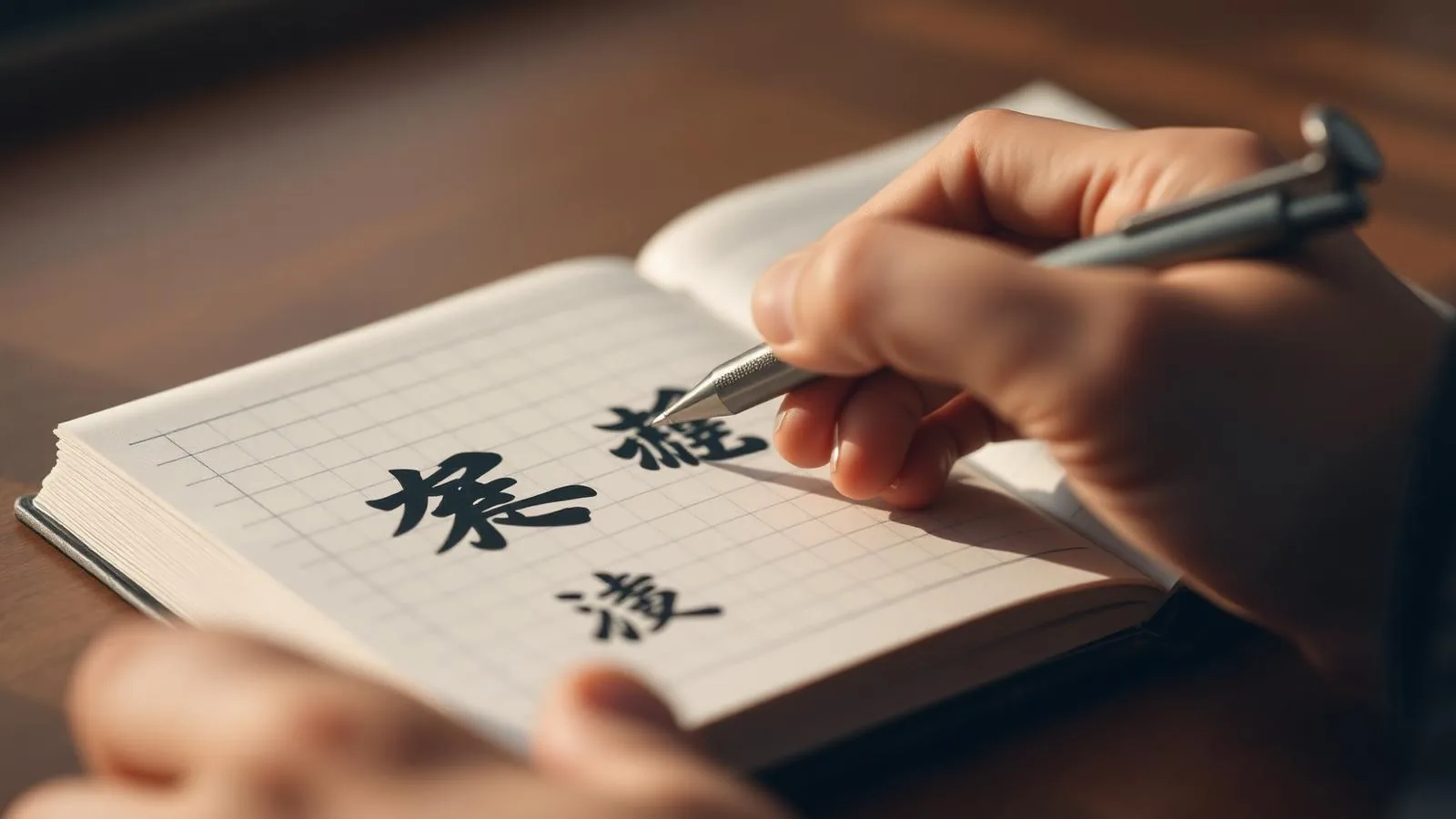
Japanese hiragana · 11 min read
·
The Origin and Use of Hiragana: The True Cornerstone of Japanese Writing
When someone sits down for their first lesson and says, "I want to learn Japanese, but the writing scares me," I almost always start with the same thing: relax, we'll begin with hiragana, and it's the friendliest part of Japanese writing. Japanese hiragana form a closed system of forty-six basic characters, which — unlike kanji — actually has an end. Once you get through it, you're done, and from then on you can read anything phonetically.
In this article I won't just list the characters. We'll look at how the hiragana writing system developed, exactly what it's for, how it relates to katakana and kanji, what mistakes beginners make, and I'll introduce the Hungarian memory rhyme — "Akasztana ha majré van" — that engraves the order of the rows into your memory within a few days.
Where does the hiragana writing system come from?
Japanese originally had no writing system of its own. The earliest written records were made with Chinese characters, used in two ways: either for their meaning as kanji, or purely for their sound. The latter was man'yōgana, named after the 8th-century poetry anthology Man'yōshū. Here, each Chinese character no longer carried its meaning but simply denoted a Japanese syllable.
The problem was that this was terribly cumbersome. Writing a single short syllable sometimes required fifteen strokes. During the Heian period (794–1185), copyists and letter-writers began writing these characters more and more fluidly, in cursive style, until eventually the forms simplified so much that they became an independent writing system. This is how hiragana was born.
- 安 → あ (a) — cursive writing gradually rounded off the strokes.
- 以 → い (i) — the right-hand element was dropped, leaving only the flowing motion.
- 宇 → う (u) — the part under the roof merged into a single curve.
- 衣 → え (e) and 於 → お (o) — the same process, just with a different starting point.
An interesting cultural twist is that hiragana was long referred to as "onnade," or "women's hand," because official texts requiring Chinese scholarship were written by men in kanji, while court ladies wrote diaries, poems, and novels in hiragana. One of the world's first novels, The Tale of Genji (by Murasaki Shikibu), was therefore written largely in hiragana. In other words, the golden age of Japanese literature was carried precisely by the writing system that beginners learn first today.
Az írásjegyek akkor rögzülnek igazán, ha valaki azonnal visszajelez a vonássorrendre és az olvasatokra. Ezt gyakoroljuk együtt a japán nyelvórákon Budapesten és online, ahol minden hétre kapsz személyre szabott íráshoz kötött feladatot is.
„Aki a rōmaji-t időben elengedi, hónapokat nyer a japántanulásban.”
What are Japanese hiragana used for?
Hiragana is not "simplified Japanese." It has a sharp, precisely defined function in the modern language: it's used to write the grammatical skeleton. If kanji is the muscle of a sentence, hiragana is the joint that moves it. Let's look at exactly what it's needed for.
- Grammatical endings (okurigana): 食べる, 読みます — the stem is kanji, the conjugation is hiragana.
- Particles: は, が, を, に, で, へ, と, も, から, まで — these mark the role of sentence elements.
- Auxiliary verbs and politeness forms: です, ます, ました, たい, ない.
- Words that have no widely used kanji, or that are traditionally written in kana: きれい, とても, ちょっと.
- Furigana: small hiragana placed above difficult kanji so you know how to read them.
- The full text of children's books and beginner materials.
This is best illustrated by a sentence: 私は毎日日本語を勉強します ("I study Japanese every day"). Here 私, 毎日, 日本語, and 勉強 are kanji, and everything else — は, を, します — is hiragana. If you only knew the kanji, you'd guess the topic, but you wouldn't know who does what to whom. Hiragana provides the sentence's logic.
That's why I always say hiragana is not a "waiting room to get through," but the very thing that makes grammar readable. Anyone who reads kana uncertainly will later also perceive grammar uncertainly, because they won't immediately see where the stem ends and the ending begins.
The "Akasztana ha majré van" mnemonic
Now for my favorite trick, which almost all of my students use. The hiragana chart is not random: it's arranged into ten rows (行, gyō), and the order of the rows is set in stone — this is called the gojūon order. This order also determines how dictionaries, name lists, timetables, and official lists are sorted in Japan, so it's not enough to know the characters — you also need to know the order.
The initial consonants of the rows are: —, K, S, T, N, H, M, Y, R, W. In Hungarian we remember this with the phrase "Akasztana ha majré van" (roughly, "He'd hang himself if he had the guts"). Let's break it down:
- A — the あ row: あ い う え お (vowels, no consonant).
- KA — the か row: か き く け こ.
- SZ — the さ row: さ し す せ そ (note: し is pronounced "shi," not "si").
- TA — the た row: た ち つ て と (ち is "chi," つ is "tsu").
- NA — the な row: な に ぬ ね の.
- HA — the は row: は ひ ふ へ ほ (ふ is more like a soft "fu," made with a gentle lip gap).
- MA — the ま row: ま み む め も.
- Y(A) — the や row: や ゆ よ (only three members).
- R(É) — the ら row: ら り る れ ろ (the Japanese "r" lies somewhere between an English r and l).
- VAN — the わ row: わ を, plus the solitary ん.
In other words: A-KASZ-TA-NA HA MAJ-RÉ-VAN → A, KA, SA, TA, NA, HA, MA, YA, RA, WA (+N). If you say this phrase three times, you already know the full backbone of the Japanese syllabary. From here, you just need to add that within every row, the order of vowels is always the same: a – i – u – e – o.
My students typically do it like this: on the first day they learn the rhyme and the あ row, then add two rows per day. The whole chart is done within five or six days, and after a week of practice they're already reading kana fluently. Someone who only studies with random flashcards usually takes three to four weeks, because there's no system to it.
How does the rhyme help with fast learning?
Memory research has long known that what makes something hard to learn isn't the number of elements, but how many independent units it breaks into. Forty-six separate characters seem like an awful lot. But ten rows of five, with a vowel order you already know, is a manageable structure. The rhyme does exactly this: it compresses the order of the ten rows into a single Hungarian sentence, giving your mind a hook to hang the characters on.
- Reduces mental load: instead of 46 elements, you only need to keep 10 groups in mind.
- Gives you an order: without it, you can't search a Japanese dictionary or a name list.
- Makes the shapes predictable: if you know you're in the か row, you expect forms similar to か.
- Prepares you for conjugation: Japanese verb conjugation moves along rows (書く → 書きます → 書かない), so the row logic later becomes a grammatical tool.
This last point is the most important, and many people miss it. When later, in verb conjugation, the verb 書く turns into 書かない, 書きます, 書けば, you're actually walking along the か row: か – き – く – け – こ. For anyone who has internalized the rows in the first week, conjugation isn't rote memorization but logic. I've written more about this in the article on verb conjugation.
Why does this matter for learning Japanese?
Hiragana is the one point in Japanese where a few days of investment saves months later. As long as you study with rōmaji (Latin-alphabet transliteration), you have three disadvantages at once: you fix bad pronunciation, you don't see grammatical boundaries, and every genuine Japanese material stays closed to you.
- Pronunciation: Japanese is mora-based, and every kana is the same length. This is invisible in rōmaji, but automatic in kana.
- Long vowels: おばさん (aunt) and おばあさん (grandmother) — the difference is a single あ, and you see it immediately in kana.
- Double consonants: きて (come) and きって (stamp) — marked by the small っ, which often gets lost in rōmaji.
- Independence: from day one you can look things up in a dictionary, read signs, and use learning materials.
That's why, in lessons, most of the first two or three sessions are devoted to reading and writing kana, alongside the first dialogues. We don't put it off, because speaking and reading reinforce each other: what you say out loud, you recognize more easily in writing, and vice versa.
Common mistakes
Over fifteen years of teaching, a few recurring pitfalls have emerged. If you know these in advance, you'll progress weeks faster.
- Rōmaji as a crutch: you write the Latin letters under the character. Two weeks later you're reading the Latin letters, not the kana. Better to read slowly, but read kana.
- Confusing similar shapes: さ and ち, ぬ and め, は and ほ, る and ろ, わ and れ. It's worth practicing these in pairs, not separately.
- Particle pronunciation: the particle は is "wa," the particle へ is "e," and を is "o." Only as particles — otherwise they're ha, he, wo.
- Ignoring stroke order: this isn't snobbery — the correct order is what makes your handwriting legible and recognizable to the drawing recognizer in dictionary apps.
- Neglecting the small つ: っ isn't decoration, it's a full mora-length pause.
- Jumping to kanji too early: many beginners switch to kanji after two days of kana, and then both remain shaky.
- Recognition only, no writing: anyone who never writes by hand fixes the shapes in memory much more slowly.
Practical examples
Let's look at concrete sentences where the role of hiragana is immediately visible. Read each one aloud — saying it out loud is half of learning.
- わたしは がくせいです。— I am a student. Here は is a particle, so it's "wa."
- きょうは あついですね。— It's hot today, isn't it? The ね is a softening conversational particle that exists only in hiragana.
- ともだちに てがみを かきました。— I wrote a letter to my friend. Here に and を show the roles.
- この りんごは とても おいしい。— This apple is very delicious. とても and おいしい are typically written in kana.
- きって を かって ください。— Please buy a stamp. Notice the small っ appearing twice.
A simple daily routine I usually recommend for the first week: five minutes in the morning repeating the rhyme and writing out two new rows by hand, ten minutes in the evening reading from a children's book or kana material. Not more, but every day. On the seventh day, try reading the kana parts of a Japanese menu — you'll be surprised how much comes together.
Read more
Learn Japanese with me
Personalized, speaking-focused Japanese lessons online and in Budapest.
Frequently asked questions
Mennyi idő megtanulni a hiraganát?+
Napi 20–30 perc gyakorlással 3–5 hét alatt megbízhatóan olvasható.
Hiragana vagy katakana legyen az első?+
A hiragana, mert ezzel írjuk a nyelvtani végződéseket és a legtöbb alapszót.
Kell kézzel írni?+
Igen. A vonássorrend gyakorlása jelentősen javítja a felismerés sebességét.
Remember this — japán hiraganák
- 1A hiragana 46 alap írásjegyből áll, ez a japán írás első és megkerülhetetlen lépcsője.
- 2Napi 20 perccel 3–5 hét alatt biztosan olvashatóvá válik.
- 3A dakuten és a yōon kombinációk logikusan épülnek az alapkészletre.
tanuljjapanul.hu · József Eckert · JLPT N1
Downloadable materials
Printable hiragana and katakana charts — download them and practise offline too.
Get free learning materials
Leave your email address and I'll send you the printable hiragana and katakana pack, plus new guides as they come out.
I only send study materials, never spam. You can unsubscribe anytime.
Related articles

Related topics
- The Origin and Use of Katakana: The Script for Foreign Words
- The Origin and Use of Japanese Kanji: From Chinese Roots to the JLPT
- What Is Man’yōgana, and What Was It Used For?
- Writing System — all articles
- Japanese language course — prices and levels
- How to start learning Japanese — a complete guide
- JLPT N5 preparation — The first step: basic vocabulary and kana
Related keywords and topics
These searches lead to this topic — you'll find detailed material for each of them here.
- hiragana chart
- learning hiragana for beginners
- reading Japanese characters
- japán tanulás kezdőknek
- japán szavak kezdőknek
- japán mondatok kezdőknek
Jelentkezz japán nyelvórára
Personalized, speaking-focused Japanese lessons online and in Budapest.
- 20+ years of Japanese language experience
- JLPT N1 level
- Years of hands-on experience living in Japan