
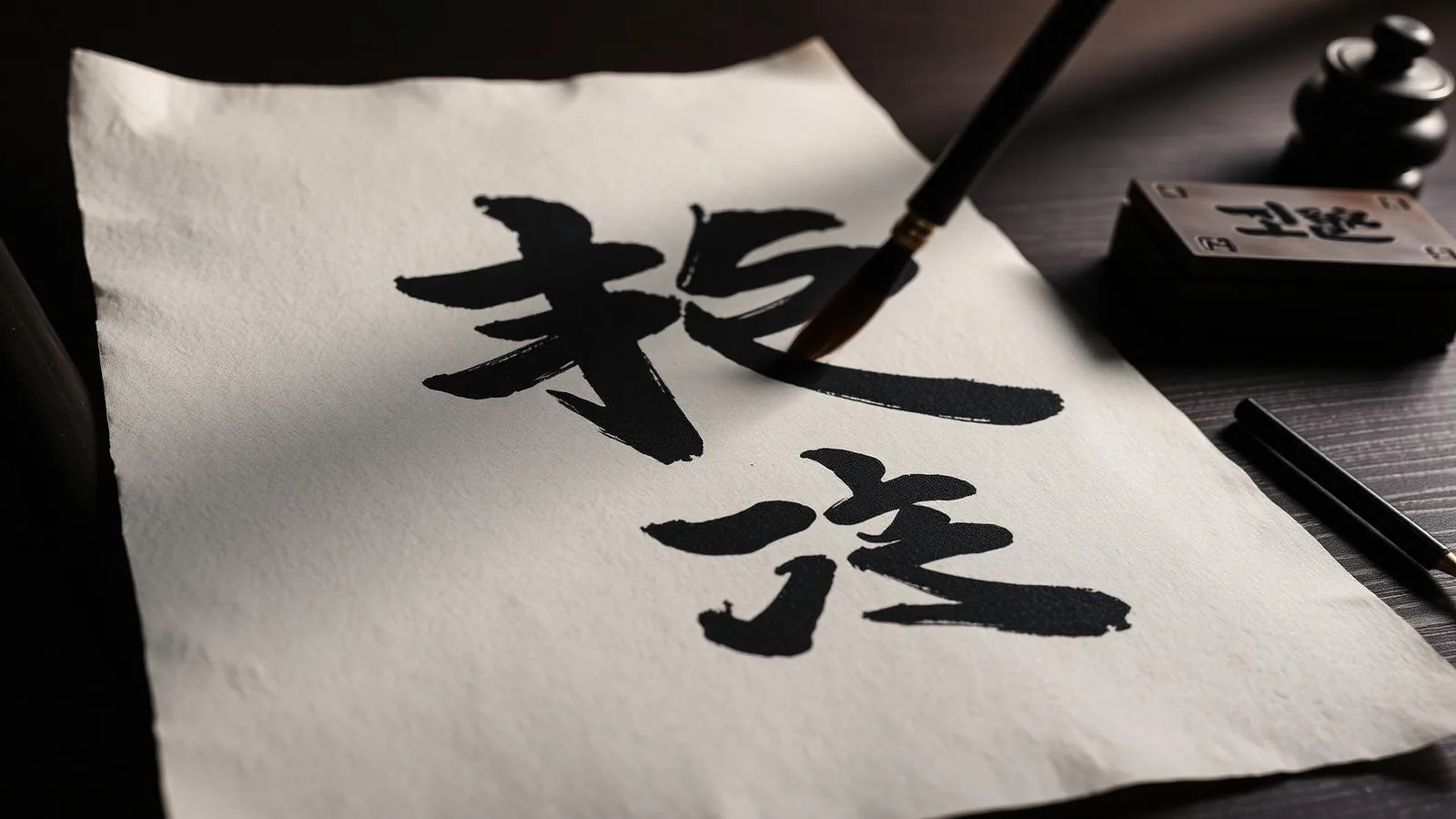
Japanese kanji · 12 min read
·
The Origin and Use of Japanese Kanji: From Chinese Roots to the JLPT
There isn't a single Japanese learner who hasn't gotten stuck on kanji at least once. Two thousand characters, several readings per character, exceptions, and names that even Japanese people can't read with certainty — it's understandable if that's intimidating. But I have good news: Japanese kanji aren't random. There's system, structure, and logic in them, and once you understand that, you'll be building instead of memorizing by rote.
In this article we'll look at where kanji came from, how they're structured, what onyomi and kunyomi are, how many JLPT kanji you need at each level, and why kanji used in personal names form a separate category.
Chinese origins: how did kanji arrive in Japan?
The word kanji literally means "characters of the Han dynasty" (漢字). The characters arrived in Japan around the 5th century AD via Korean intermediaries, along with Buddhist texts and administrative documents. At that time the Japanese had no writing system of their own, but their language was structurally radically different from Chinese: Chinese is an isolating language, Japanese an agglutinative, inflecting one — they differ roughly as much as Hungarian and English, only more so.
This tension gave rise to the whole complexity of Japanese writing. The Japanese adopted the characters along with their meanings, but also attached their own native words to them. As a result, at least two readings became attached to a single character: the pronunciation distorted from Chinese, and the original Japanese word.
The characters themselves are not random either. They can be roughly sorted into four large groups:
- Pictograms: simplified from drawings of the object. 山 (mountain), 川 (river), 木 (tree), 日 (sun).
- Simple ideograms: marking abstract concepts. 一, 二, 三, 上, 下.
- Compound ideograms: the meanings of two characters combine. 休 = 人 (person) + 木 (tree), i.e. rest.
- Phonetic-semantic characters: roughly 80–90 percent of kanji are of this type. One element provides the meaning, another the pronunciation. For example, 時 (time): the 日 sun radical gives the meaning field, while 寺 provides the "ji" reading.
This last point is pure gold for learning. If you recognize the radicals (bushu) and the phonetic elements, you can even guess the reading of an unfamiliar kanji. The characters 清, 晴, 精, and 請 all have the reading "sei," because they all contain the element 青.
Az írásjegyek akkor rögzülnek igazán, ha valaki azonnal visszajelez a vonássorrendre és az olvasatokra. Ezt gyakoroljuk együtt a japán nyelvórákon Budapesten és online, ahol minden hétre kapsz személyre szabott íráshoz kötött feladatot is.
„A kandzsit nem megtanulni kell, hanem újra és újra találkozni vele.”
Onyomi and kunyomi: the logic of the two readings
This is the point where most learners lose the thread, even though it's simpler than you'd think. Onyomi (音読み) is the character's Chinese-derived "sound reading," while kunyomi (訓読み) is its native Japanese, meaning-based reading.
- 山 — onyomi: サン (san), kunyomi: やま (yama). 富士山 = Fuji-san, but 山 on its own is yama.
- 人 — onyomi: ジン/ニン, kunyomi: ひと. 日本人 = nihonjin, but 人 on its own is hito.
- 水 — onyomi: スイ, kunyomi: みず. 水曜日 = suiyōbi, 水 on its own is mizu.
- 生 — the notorious example: セイ, ショウ, いきる, うまれる, なま, き… more than ten readings.
There's a very useful rule of thumb that works in the vast majority of cases: if a kanji stands together with another kanji in a compound, it typically takes the onyomi reading. If it stands alone, or has a hiragana ending (okurigana) attached, it takes the kunyomi reading.
- 食事 (shokuji, meal) — compound, onyomi.
- 食べる (taberu, to eat) — followed by okurigana, kunyomi.
- 電話 (denwa, telephone) — two kanji, both onyomi.
- 話す (hanasu, to speak) — kunyomi with a conjugated ending.
I don't recommend memorizing readings in separate lists. It's far more effective to learn them in words: if you learn the words 電話, 会話, and 話す, both readings of the kanji 話 come naturally. Vocabulary is the carrier, kanji the byproduct — not the other way around.
JLPT kanji: how many do you need at each level?
The JLPT does not officially publish a required kanji list, but analysis of past exams gives us a fairly stable picture of what to expect. These numbers are excellent for planning purposes.
- N5: approx. 100 kanji and 800 words — everyday basics, numbers, days, basic verbs.
- N4: approx. 300 kanji and 1500 words — simple everyday texts.
- N3: approx. 650 kanji and 3750 words — this is the big leap, where the language becomes usable.
- N2: approx. 1000 kanji and 6000 words — newspaper articles, workplace communication.
- N1: approx. 2000+ kanji and 10,000 words — professional and literary texts.
For comparison: the jōyō kanji list defined by the Japanese Ministry of Education, which a Japanese person masters by the end of high school, consists of 2,136 characters. In other words, N1 is roughly the reading level of native basic literacy.
Regarding pace: with five new kanji a day and regular review, N5 material takes three weeks, and reaching N4 takes a few months. The N3–N2 stretch is the longest, and this is where most independent learners tend to get stuck, because the number of compound words explodes. I've also written a detailed separate article on JLPT preparation.
Kanji used in personal names
This is an area where even Japanese people themselves are uncertain, which is also what makes it exciting. For names, in addition to the jōyō list, the jinmeiyō kanji list can also be used — this currently permits about 863 additional characters specifically in personal names. This means names can contain kanji you won't encounter anywhere else.
Names also have their own special readings, called nanori. A nanori reading cannot be used as a common word, only in a name. This is why a Japanese person's business card sometimes has furigana above their own name — without it, the other party wouldn't know how to pronounce it.
- 翔 — "shō/kakeru," flying, soaring. Extremely popular in boys' names: 翔太 (Shōta).
- 陽 — sun, sunlight: 陽菜 (Hina), 太陽 (taiyō, sun).
- 美 — beauty, a classic element in girls' names: 美咲 (Misaki), 恵美 (Emi).
- 健 — health, strength: 健太 (Kenta).
- 愛 — love: 愛 (Ai), 愛子 (Aiko).
- 子 — "child," the characteristic ending of older generations' female names: 花子, 洋子.
Surnames are a world of their own: 佐藤 (Satō), 鈴木 (Suzuki), 高橋 (Takahashi), 田中 (Tanaka) — there are more than one hundred thousand different Japanese surnames, and many of them are read irregularly. The kanji 一 in a surname can be read "ichi," "hajime," "kazu," or even "ninomae."
As a foreigner, you usually write your name in katakana, but many of my students like to choose a so-called ateji name for themselves, assigning kanji to their name based on sound. This is a playful and useful exercise, but it's important to double-check the meaning so you don't end up with an unfortunate combination.
Why does this matter for learning Japanese?
Japanese has no spaces. Kanji is what visually segments a sentence and instantly conveys the core of its meaning. Someone who only reads kana literally understands more slowly and less confidently — the sentence 私はきょうきょうとにいきます is agony in kana, but with kanji (私は今日京都に行きます) it's a single glance.
- Reading speed: with kanji you process text three to four times faster.
- Distinguishing homonyms: きかい can be 機械 (machine) or 機会 (opportunity) — only the kanji settles it.
- Vocabulary building: if you know the character 電 (electricity), then 電車, 電気, 電話, and 電池 all become logical.
- Workplace use: you cannot read an email, contract, or technical description without kanji.
Common mistakes
- Memorizing all readings at once. Learn words instead — the readings will follow.
- Ignoring stroke order — this makes handwriting illegible and drawing-based dictionary lookups useless.
- Confusing similar characters: 人/入, 士/土, 未/末, 千/干, 大/犬.
- Recognition only, no writing. Active writing fixes things much more deeply.
- Lack of repetition: 15 minutes of flashcards a day is worth more than a three-hour cram session once a week.
- Learning without context: an isolated character evaporates, while one embedded in a sentence sticks.
- Starting too early: learning kanji without kana is practically impossible.
Practical examples
Let's look at how a kanji family is built, and why it's worth thinking in terms of radicals.
- 氵 (water radical): 海 (sea), 池 (pond), 洗 (to wash), 温 (warm) — each connected to water.
- 言 (speech radical): 話 (to speak), 語 (language), 読 (to read), 説 (to explain).
- 木 (tree radical): 林 (grove), 森 (forest), 校 (school), 机 (desk).
- 心 / 忄 (heart radical): 思 (to think), 感 (to feel), 忙 (busy), 悲 (sad).
A daily routine that works: 10 minutes of review with a flashcard app in the morning, introducing 5 new characters together with words during the day, and in the evening writing each one out by hand five times and composing your own sentence with each. Your own sentence is the key — your brain retains personal content far longer.
Read more
Learn Japanese with me
Personalized, speaking-focused Japanese lessons online and in Budapest.
Frequently asked questions
Hány kandzsi kell a JLPT N5-höz?+
Nagyjából 100 írásjegy és 800 szó.
Érdemes radikálisokat tanulni?+
Igen, a gyökök ismerete gyorsítja a felismerést és a szótárazást.
Elég az alkalmazás a kandzsihoz?+
Ismétlésre kiváló, de a helyes vonássorrendhez és a szóhasználathoz tanári visszajelzés kell.
Remember this — japán kandzsik
- 1A mindennapi íráshoz kb. 2136 jōyō kandzsi tartozik, de az első 300 lefedi a szövegek jelentős részét.
- 2A kandzsit szavakban érdemes tanulni, nem izolált írásjegyként.
- 3Az on- és kun-olvasat közti választás a szókörnyezetből következik.
tanuljjapanul.hu · József Eckert · JLPT N1
Downloadable materials
Printable hiragana and katakana charts — download them and practise offline too.
Get free learning materials
Leave your email address and I'll send you the printable hiragana and katakana pack, plus new guides as they come out.
I only send study materials, never spam. You can unsubscribe anytime.
Related articles

Related topics
- The Origin and Use of Hiragana: The True Cornerstone of Japanese Writing
- The Origin and Use of Katakana: The Script for Foreign Words
- What Is Man’yōgana, and What Was It Used For?
- Writing System — all articles
- Japanese language course — prices and levels
- How to start learning Japanese — a complete guide
- JLPT N5 preparation — The first step: basic vocabulary and kana
Related keywords and topics
These searches lead to this topic — you'll find detailed material for each of them here.
- learning kanji
- kandzsi olvasatok
- meaning of Japanese characters
- JLPT felkészítés
- japán nyelvvizsga szintek
- JLPT N5 követelmények
- japán nyelvvizsga Budapest
Jelentkezz japán nyelvórára
Personalized, speaking-focused Japanese lessons online and in Budapest.
- 20+ years of Japanese language experience
- JLPT N1 level
- Years of hands-on experience living in Japan